
Should I go to the Employment Relations Authority ?
If an employment problem is not resolved during or after mediation, you have some options about what to do next. One is to simply drop the matter and take no further action; another is to make a settlement offer in a calderbank letter; another is to go to the Employment Relations Authority (ERA).
The decision to go to the ERA needs to be carefully considered including the likely costs and potential (meaning unknown) risks. If you have a great case with really good evidence, then the risk is likely to be low and the chance of getting a good award of compensation is likely to be high – but this can never be guaranteed. Every case is different and there are a number of factors to consider in deciding whether it’s a sensible decision to take your case to the ERA.
What happens at the Employment Relations Authority (ERA).
The ERA is not a court; it is a tribunal which means it can investigate whatever it likes (relevant to the employment relationship), in any way it likes, and then make whatever decision it likes. That is quite different to how the Employment Court operates.
This video outlines the ERA process, which is summarised below.
To start this process, we send the ERA a “Statement of Problem”, followed some months later by the “Brief of Evidence” (collectively the “submissions”) for you and your witnesses (if any). We may also need to deal with any preliminary issues and the ERA might ask for submissions on various legal arguments.
Once the ERA has read all submissions, they have the choice to hold a “Investigation Meeting / Hearing” or make a decision “on the papers”. A hearing is where both parties and their representatives will go to the ERA building (or virtually attend) to present our case. An “on the papers” decision is based on the written submissions from both sides. Once the Member has heard/read the submissions from both sides they will then issue their decision, a few weeks or a few months later.
Members can choose to:
· Dismiss some or all of the claim/s;
· Reinstate employment (possibly);
· Award compensation – for the unfairness of what happened;
· Award “lost wages” for the time spent unemployed (generally no more than 12 weeks);
· Award a penalty – generally for misconduct of some sort by the employer (paid to the Crown or the employee) – but this can be awarded against an employee;
· Facilitate bargaining and issue recommendations - very rare.
Compensation.
The media always reports the huge awards to employees, which has created a misleading impression that you are highly likely to win significant money in the ERA. For example, the headline to the article below says that “School Counsellors Win 1.8 Million For Workplace Stress Over Student Suicides, Deaths”. That should tell you right straight away that this was highly unusual circumstances (and this decision is under appeal).
ChatGPT and other AI sources often refer to these more uncommon cases, and then mislead you to say awards like these are common – when they are not. The reality is very different - see the table below – 72.8% of people who filed claims in the ERA did not receive any compensation. That is almost 3 out 4 people – who spent money going the ERA - and received nothing!
Summary of the 852 ERA Determinations issued in 2025
In 2025 231 applicants were awarded compensation as a remedy for a successful personal grievance. The lowest compensation award was $1,000, and the highest was $105,000.
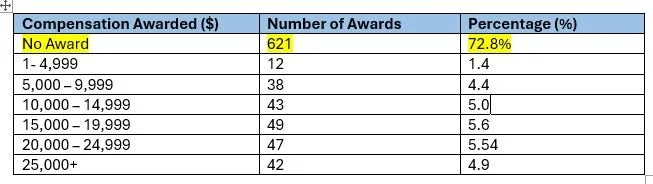
Source: Employment Relations Authority Annual Report 2025
Costs
One of the most important things to consider is the cost. A straightforward one-day hearing (with one or two witnesses) in the ERA will cost somewhere around $10,000 to $15,000 plus GST. A hearing over a number of days with both parties calling several witnesses could easily cost much more. Some of the bigger law firms can easily charge this much per day, if not more.
The ERA typically makes a costs award in favour of the successful party, at the standard rate of $4,500 for the first (full) day and $3,500 for any subsequent days. This is very unlikely to cover all your legal fees. So, if you are pursuing a clearly unfair dismissal with great evidence then costs of somewhere around $10k or so against a potential award of somewhere between $20 and $40 K (or more) is well worth both the cost and the risk. But if you are claiming something like an unpaid (and disputed) $5000 bonus then the costs of the ERA are likely to far exceed any award – presuming you actually win your case.
But – talk to us - if we both think you have a great case but you cant afford legal fees; we may be able to work something out.
Getting the Money…
Presuming that you have been the ERA and have been awarded significant compensation, the next issue getting the money. It is a fact that some employers do not pay the money - despite being ordered to do so by the ERA.
We recently acted for an employee who was awarded a little over $26,000. The employer refused to pay, and the employee could not afford to continue litigation in the Employment Court trying to enforce the decision of the ERA. This employer - the Port Hills Charitable Trust – appeared to have no or little assets / the director had been bankrupt before, and they refused to cooperate with the ERA or attend the investigation. Our client was gutted – the ERA agreed she had been unfairly dismissed - and then the employer refused to pay anything.
If you are awarded compensation and the employer does not pay then you will be forced to seek enforcement through the Employment Court, which can be quite expensive. The Employment Court can make a variety of orders. One option is to make a director personally liable (for some claims) so that you can bankrupt the owner of the company if the employer wont pay. There are other options, but they all cost money.
Conclusion
In conclusion, it is important to know there is always risk in taking a case to the ERA. ERA members are human, and they will see your circumstance through their own eyes and come to their own conclusion. No matter how good that we both believe your case is, the risk is the ERA may see things differently.
The best result is a good award of compensation and legal fees are more than just covered. So that means an award of something like $15 to $20 k. But - the worst result is no compensation, a bill for your own legal fees as well as an order to pay $4,500 towards the other parties fees.
Everything turns on having a good case with great evidence - and that’s not based on the opinion of you and your friends or ChatGPT. We must have good evidence to prove what has gone on, and even then, that does not guarantee a win.
PB Employment Lawyers have taken dozens and dozens of cases to the ERA over more than 20 years, so we have the experience to give you good honest advice about whether it is a good idea to go to the ERA.
If you are still unsure about what to do, give us a call and lets have a chat . . . .